

Re-read last meeting's decisions and open actions, look up the people and the company, write down the one outcome you want, and bring a one-page brief — 15 minutes is enough, and here is the minute-by-minute routine with variants for a boss, a client, a board and an interview.
The order matters. Starting with the last meeting stops the same conversation from resetting to zero. Looking up the people helps you choose useful questions. Naming one outcome gives the meeting a finish line. The brief keeps all of that visible while you talk.
This routine works for a regular meeting with information already available. A negotiation, formal board session, job interview or sensitive HR conversation may need a longer review. Use the 15 minutes to establish the spine, then add the preparation the risk deserves.
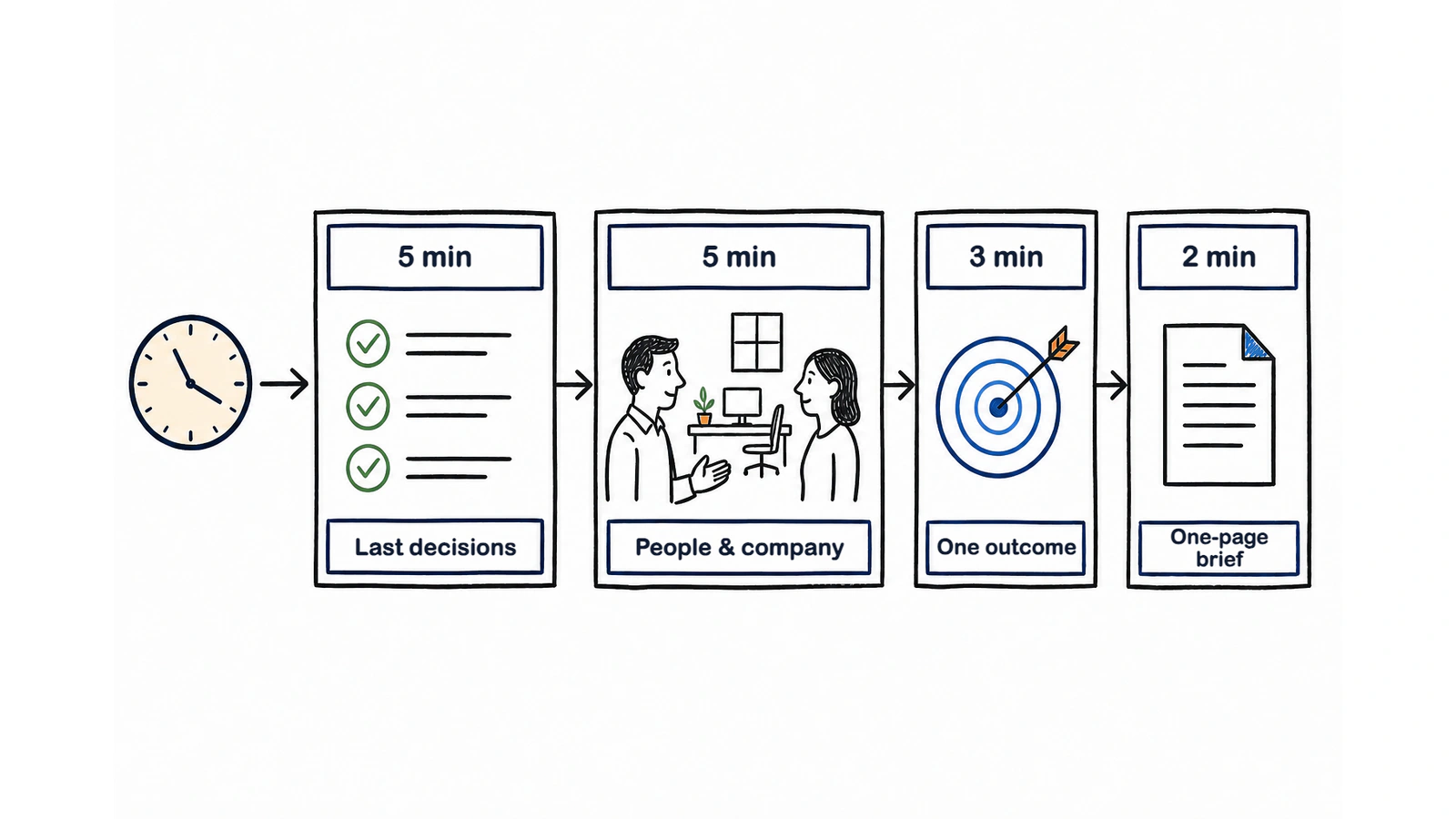
The 5-5-3-2 rule: 5 minutes on the last meeting, 5 on the people and company, 3 on your outcome and 2 on a one-page brief.
What does good preparation actually change?
Good preparation makes a decision easier to reach because everyone can start from the same context and knows what must be settled.
The weak version of preparation is cosmetic. Someone fixes slides while the real question remains unnamed. Microsoft found that PowerPoint edits rose 122% in the final 10 minutes before meetings in its 2025 analysis of aggregated Microsoft 365 activity, excluding EU and education tenants. That rush may improve a deck, but it does not recover a missing objective.
The objective is often missing. In Atlassian's 2024 survey of 5,000 knowledge workers across 4 continents, 62% said they attend meetings with no stated goal. Good preparation changes that before anyone joins. You know the prior decision, the open action, the desired outcome and the person who can move it forward.
Preparation also protects focus. In Microsoft's 2023 Work Trend Index, based on a survey of 31,000 people in 31 countries alongside Microsoft 365 signals, 68% said they lacked enough uninterrupted focus time. A short routine is realistic in a crowded day because it places a hard boundary around preparation. You stop collecting background when you have enough to ask the right question.
How do you prepare for a meeting in exactly 15 minutes?
Prepare in four timed blocks: 5 minutes for continuity, 5 for people and company context, 3 for your outcome and 2 for the brief.
| Minute block | What to do | Output |
|---|---|---|
| 0–5 | Re-read the last summary, decisions and unfinished action items | 2-line continuity note |
| 5–10 | Check each attendee's role and one relevant company or project update | Attendee notes with source links |
| 10–13 | Write the single decision, answer or commitment you want | 1 outcome sentence |
| 13–15 | Put the useful facts and 3 questions on one page | Meeting brief |
Set a timer. Do not turn the research block into a browser expedition. A person's role, their connection to the topic and one current fact are usually enough. If a fact might change how you act, save its source. If it will not affect the conversation, leave it out.
Copy this checklist into the calendar description or your notes app:
15-MINUTE MEETING PREP
[ ] Last decision reread
[ ] Open actions checked: owner + due date
[ ] Each attendee's role confirmed
[ ] One relevant company/project update sourced
[ ] One desired outcome written as a sentence
[ ] Three questions selected
[ ] One-page brief open before joining
At minute 15, stop. A brief with a visible gap is more useful than an unfinished research document. Mark the gap as a question for the room.
What was decided last time?
The last meeting's decisions and open actions come first because they define what this meeting is continuing, correcting or closing.
Start with the nearest reliable record: approved minutes for a formal body, the previous summary for a team meeting, your own notes for a 1:1, or the shared decision log for a project. Pull out only four things:
- The last decision in one sentence.
- Each unfinished action with its owner and due date.
- Any assumption that has changed since then.
- The open question that caused this meeting to be booked.
Do not reread the whole transcript unless a disputed detail requires it. Search for the project, decision or person. If you use an agent with access to your meeting history, ask: What did we decide about the launch date, which actions are still open, and what source meeting supports each answer?
The source requirement matters. Atlassian's 2025 State of Teams survey of 12,000 knowledge workers found that 72% felt the only way to get needed information was to ask someone or book a meeting. A searchable history can remove that retrieval meeting, but only if the answer points back to the conversation it came from. Read more about how meeting memory works.
Who is in the room, and what do they want?
Research each attendee's role, stake in the topic and likely question; then note one current fact about the company or project that could change the discussion.
For an internal meeting, the organisation chart and project tracker may tell you more than a public profile. For an external meeting, check the company site, a recent announcement and the person's stated remit. Five minutes is enough for a small attendee list when you look for relevance instead of biographies.
Write one line per important attendee:
Name — role in this decision — likely priority — question to ask
For example: Finance lead — owns the budget — needs a defendable payback period — ask which cost assumptions the team will accept. That line tells you how to involve the decision-maker. Their education history does not.
Keep external research sourced. Put the link beside the fact, preserve its date, and label an inference as an inference. If you cannot verify a claim, turn it into a question: “I saw that the team may be expanding in Japan. Is that still the plan?” This is both safer and more useful than presenting a stale fact with confidence.
What is the one outcome you want?
Your outcome is one observable result that can exist when the meeting ends: a decision, an answer, an approval, an owner or a committed next step.
Write it as a sentence beginning with “By the end of this meeting…”:
- “By the end of this meeting, we will choose the launch date and name the owner of each dependency.”
- “By the end of this meeting, I will know which 2 changes my manager wants before review.”
- “By the end of this meeting, the client will confirm which problem belongs in the first proposal.”
Avoid outcomes such as “align,” “discuss the project” or “have a productive conversation.” You cannot tell when they have happened. If the decision cannot be made today, define the next best result: identify the missing evidence, its owner and the date when the decision will be made.
Then choose the question that opens the way to the outcome. A request for approval might need “What evidence would stop you from approving this today?” A discovery conversation might need “Which part of the current process creates the cost you most want to remove?” Put that question at the top of your brief.
What goes in a one-page meeting brief?
A one-page meeting brief contains the current context, last decisions, open actions, relevant people, your desired outcome and the 3 questions that move the meeting forward.
One page forces useful selection. It is not a smaller slide deck or a transcript. A reader should be able to scan it in a minute and know why the meeting exists, what has already been settled and where input is needed.
Use this copyable template:
MEETING BRIEF
Meeting:
Date:

CONTEXT
Why this meeting is happening now:

LAST DECISIONS
- Decision — source meeting/date

OPEN ACTIONS
- Owner — action — due date — status

PEOPLE
- Name — role in this decision — likely priority

ONE OUTCOME
By the end of this meeting, we will…

THREE QUESTIONS
1.
2.
3.

SOURCES / GAPS TO CONFIRM
- Link or open question
Imagine the “Meeting prep” brief for a renewal call. It opens with the last agreed scope, lists the promised usage report as still open, identifies the client sponsor and procurement lead, and names the outcome: agreement on the renewal path. Three questions cover value, risk and process. That is enough to enter the call with continuity. Meeting.ai can assemble this kind of brief from your history and external research; the product overview is available at Meeting.ai.
How does the checklist change for each kind of meeting?
The 5-5-3-2 structure stays the same, but the evidence, desired outcome and risk checks change with the meeting.
How do you prepare for a meeting with your boss?
Bring evidence of progress, not a spoken version of the project tracker. First, review what you promised in the last 1:1 and flag anything blocked. Second, choose the one decision, feedback point or piece of support you need from your manager. Third, prepare a direct question and a recommendation, so your boss has something concrete to respond to.
How do you prepare for a client or prospect meeting?
Start with the client's words: their stated problem, prior objections and every promise your team made. Then check one current company fact that could affect timing, budget or priorities. Finally, define a customer-side commitment that fits the stage, such as access to a stakeholder, confirmation of requirements or a date for the next decision. Do not force a close when the missing outcome is understanding.
How do you prepare for a board or committee meeting?
Use the agenda, previous approved minutes and decision papers as the record. Identify which items are for information, discussion or approval. Then confirm the exact wording of the proposed resolution, the evidence supporting it and any declared conflict or procedural requirement. A board or statutory committee can have formal rules; check them with the chair or secretary rather than treating the session like a project sync.
How do you prepare for a meeting with HR?
Build a dated, factual timeline and bring the records that support it. Identify the policy, process or workplace question you need explained. Then write the outcome you want without overstating what HR can decide. For a grievance, disciplinary matter or investigation, ask in advance about attendees, representation, confidentiality, note-taking and recording. Sensitive or legally significant matters may need qualified advice beyond a 15-minute brief.
How do you prepare to interview a candidate?
Re-read the role requirements and the candidate's evidence against the same criteria used for everyone else. Choose 3 structured questions that test the job's real work, plus follow-ups that ask for the candidate's specific contribution. Then agree with the interview panel who covers each competency and how notes will be scored. Keep protected characteristics and irrelevant personal research out of the brief.
How can an agent prepare the brief for you?
An agent can turn the topic, last meeting record and attendee list into a sourced first draft, but you must review its facts, access and recommendations.
With Meeting.ai, you can ask Memo what was decided in earlier meetings, which actions remain open and where each answer came from. Add the attendee names and topic, and the agent can research the company and people into a brief with sources. It can also draft a ready-to-present deck or build a spreadsheet with live formulas when the meeting needs more than a page. See how meeting research fits the before-meeting workflow.
The best instruction is specific about evidence and output:
Prepare a one-page brief for Friday's client renewal meeting. Start with decisions and open actions from our last 3 meetings. Research the attendees' current roles and the client's relevant public announcements. Cite every external fact. End with one recommended outcome and 3 questions. Mark anything you cannot verify.
Review the result before sharing it. Check names, dates, permissions, confidential material and every claim that could change a decision. An agent shortens retrieval and drafting; it does not own your judgement.
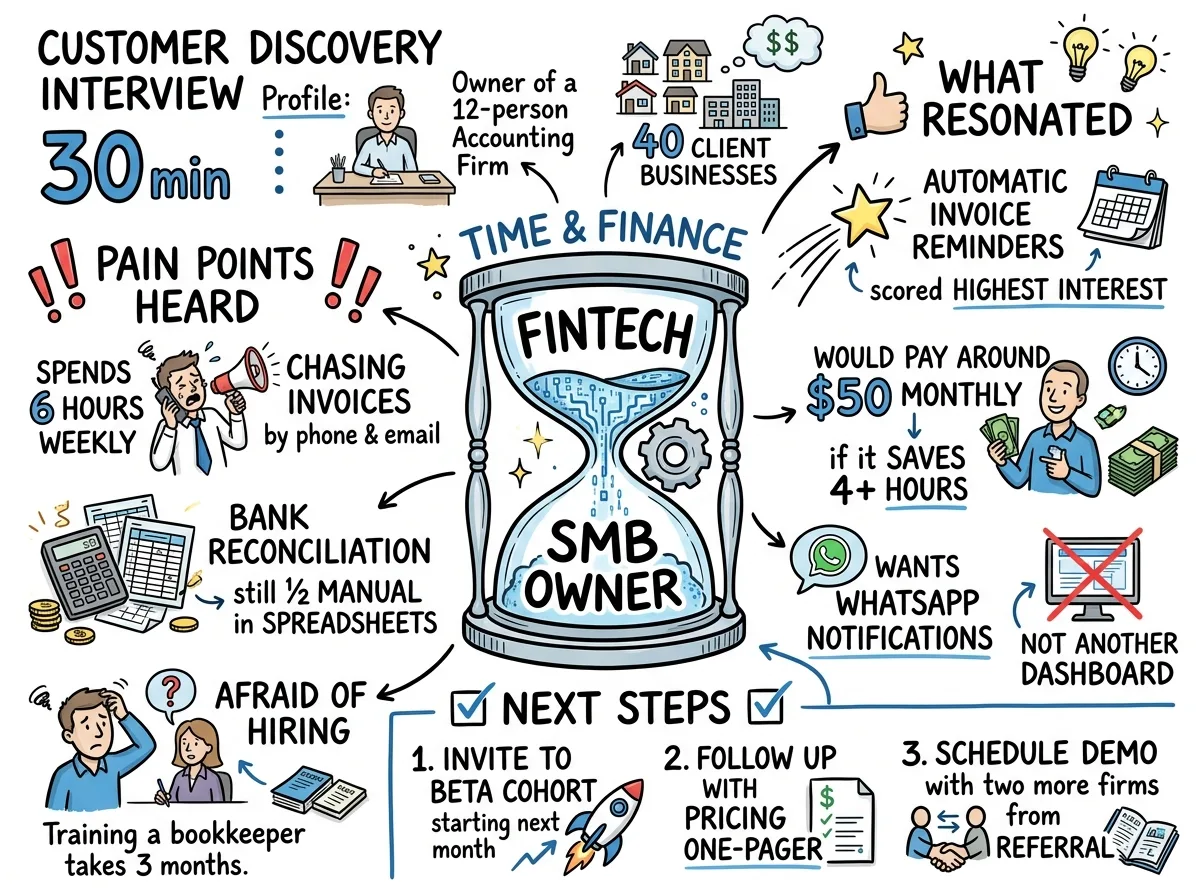
A Visual Note from the previous meeting gives you a one-page view of the main topics, decisions and action items. Use it as the starting map, then open the time-stamped transcript when exact wording matters.
What should happen after the meeting?
Close the loop within 24 hours by recording decisions first, assigning every action and carrying unresolved questions into the next brief.
Your minutes or recap should answer four things: what was decided, what was not decided, who owns each next step and when it is due. Send the record while people can still correct it. For a formal board or committee, follow its approval and distribution process instead of using an informal recap.
Then make the next preparation easier. Link each action to an owner. Store the source meeting with the decision. Add the unresolved question to the next agenda. Our guide to writing meeting minutes shows how to turn the conversation into that durable record.
The 15-minute routine becomes faster each time the loop is complete. Meeting.ai keeps the transcript, AI-Powered Summary, action items and Visual Note together, so the next brief can begin with what the team actually said instead of another round of reconstruction.